Here is a scenario.
"You have been training for months and months for races. You mostly enjoy your days, enjoy the pain, and love how a good training day makes you feel. You even love and learn to cope with less than optimal days where something wasn't right. You train hard, day in and day out. All of a sudden, things change. You develop dislike (and sometimes even hate) towards your daily regimen. You do not look forward to getting in the water, you begin to slowly hate your bike, and you can't stand running. You feel mentally and physically exhausted and all you want to do is to do everything else but train."
This actually happened to me this week. I've been training hard for both American River 50 mile run and Ironman Canada for a number of months with almost no break, charging full steam ahead. This past weekend was the Wildflower Triathlon. The events went fine. I didn't do as well as I hoped I would do but I also didn't enjoy them as much as I did in the years past. After returning back to Los Angeles, Katherine and I tried a 3 mile run. I absolutely hated it. Every second of it. From then on, I basically lost all interest in training. I didn't want to get in the water, sit on a saddle, and worse of all, run. This was unlike me. All I wanted to do is eat, watch TV, and sleep. Needless to say (and without much of an option), I listened to my body. I didn't force myself, I took some time off from training and did exactly that, eat and watch TV. It was every bit as enjoyable as I thought it would be. Then, something funny happened last night.... I began to crave running again. Not just 'wanting' but actually craving. So I ran, with no expectations, no goals. I ran to run. I loved it and now, I am back. Recharged and ready to tackle the next few months of intense training for Ironman Canada.
Why am I saying this? Burnouts happen to us all. Don't push through them. Don't do anything you hate, life is too short for that. Take time off and do something you like. Learn a new skill, visit family and friends, have fancy dinners, or do whatever you basically want. Burnouts are temporary but if you constantly force yourself without giving your body and mind the opportunity to recover, then the consequences can be long-lived and even permanent. You'll come back better, stronger, and more importantly, happier. Taking time off is important for both your mind and body. Thank you for reading.
Friday, May 11, 2012


Friday, April 27, 2012
Do it, Now!
It's been more than 2 years since I wrote anything. As with my previous post, a very brief update of what I've been up to since December of 2010. These past two years have been amazing from the training and racing standpoint. Lots of hard work led to many personal records (PR) and new distances. Distance, which I would have never imagined I could do.
I do remember several years back before I was into endurance sports, I went to visit my family in Fresno. While cleaning my car in front of our house, I saw a runner pass by. He looked so peaceful and focused. Watching this person run really made a dent in my brain and all I could think of at that moment in time was, "wow, I wish I was him. I wish I could do that". Of course, that dent quickly went away and as soon as I finished washing my car, I went back inside, sat in front of the TV and ate a whole jar of peanuts. This was during a time of my life where walking around the block would leave my gasping for air. It was a time where when I went to buy ice cream from Albertsons grocery store located directly in front of my apartment (less than 2 min walk), I would take my car. Clearly, the inspiration I received from that particular runner was very short-lived.
So, what's the point? The internet is full of inspirational quotes, photos, full of motivation. In this day and age of social media, all you have to do is log on facebook and no matter how many friends you have, you'll see photos/posters filled with wise sayings, TED talks, and quotes that would almost make you want to get off the chair and do something. ALMOST!!! Go to any bookstore and they have a whole section dedicated to self-help books. Hundreds and hundreds of them telling you how to be a better person. That person running was one of my many short-lived inspirations. I've had hundreds and did absolutely nothing. They fell in the back of my head and slowly escaped through my ear openings.
Here is one of my favorite quotes... I've used this dozens of times:
"A journey of a thousand miles begins with a single step" - Lau Tzu
Thousands of people see/read this quote every day. Millions of people every day watch Nike commercials with their slogan "Just do it" or Adidas' "Impossible is nothing". How many people "just do it" after watching it? At most, they'll probably go buy the shoes with good intentions. It's not a coincidence that right after Thanksgiving the ads on TV become healthier. You can't turn your head anywhere without seeing the word "resolution". What does that even mean and why do you need a specific date to change your life?
Again, what is my point? The point is to take that first step. Did you always wanted to start walking regularly? Did you wish you could do a marathon? How about spend more time with your family? Well, as soon as you're done reading this, put your shoes on and go for a walk. Don't wait till tomorrow. Don't even wait until after dinner... it's not going to happen. Too many excuses will come up (pick from this list...1. too full to walk/run, 2. need to help my kid with homework, 3. America's Next Top Model is going to start, etc). Do it now! In fact, don't even bother reading the rest of this. I wont be hurt, promise. Walk out the door or do whatever you think the first step is to completing your goal. This is the HARDEST step because there is always an excuse not to do something. The amount of pride you will feel AFTER you're done is impossible to put into words. You did it, you took the first step, and no one can take that away from you. Congratulations!
Ok, now... what was I talking about? Oh yeah, what have I done since December 2010... Let's see if I can summarize this:
- I ran a few more marathons with very happy times, I ran the Boston marathon in 2011, finished a couple of 50 mile races, set a new PR at an Ironman distance race. I'm sure I'm forgetting something, somewhere. Oh well.
Thanks for reading. Until the next time (I promise to NOT wait for 2 years).
Arkady
I do remember several years back before I was into endurance sports, I went to visit my family in Fresno. While cleaning my car in front of our house, I saw a runner pass by. He looked so peaceful and focused. Watching this person run really made a dent in my brain and all I could think of at that moment in time was, "wow, I wish I was him. I wish I could do that". Of course, that dent quickly went away and as soon as I finished washing my car, I went back inside, sat in front of the TV and ate a whole jar of peanuts. This was during a time of my life where walking around the block would leave my gasping for air. It was a time where when I went to buy ice cream from Albertsons grocery store located directly in front of my apartment (less than 2 min walk), I would take my car. Clearly, the inspiration I received from that particular runner was very short-lived.
So, what's the point? The internet is full of inspirational quotes, photos, full of motivation. In this day and age of social media, all you have to do is log on facebook and no matter how many friends you have, you'll see photos/posters filled with wise sayings, TED talks, and quotes that would almost make you want to get off the chair and do something. ALMOST!!! Go to any bookstore and they have a whole section dedicated to self-help books. Hundreds and hundreds of them telling you how to be a better person. That person running was one of my many short-lived inspirations. I've had hundreds and did absolutely nothing. They fell in the back of my head and slowly escaped through my ear openings.
Here is one of my favorite quotes... I've used this dozens of times:
"A journey of a thousand miles begins with a single step" - Lau Tzu
Thousands of people see/read this quote every day. Millions of people every day watch Nike commercials with their slogan "Just do it" or Adidas' "Impossible is nothing". How many people "just do it" after watching it? At most, they'll probably go buy the shoes with good intentions. It's not a coincidence that right after Thanksgiving the ads on TV become healthier. You can't turn your head anywhere without seeing the word "resolution". What does that even mean and why do you need a specific date to change your life?
Again, what is my point? The point is to take that first step. Did you always wanted to start walking regularly? Did you wish you could do a marathon? How about spend more time with your family? Well, as soon as you're done reading this, put your shoes on and go for a walk. Don't wait till tomorrow. Don't even wait until after dinner... it's not going to happen. Too many excuses will come up (pick from this list...1. too full to walk/run, 2. need to help my kid with homework, 3. America's Next Top Model is going to start, etc). Do it now! In fact, don't even bother reading the rest of this. I wont be hurt, promise. Walk out the door or do whatever you think the first step is to completing your goal. This is the HARDEST step because there is always an excuse not to do something. The amount of pride you will feel AFTER you're done is impossible to put into words. You did it, you took the first step, and no one can take that away from you. Congratulations!
Ok, now... what was I talking about? Oh yeah, what have I done since December 2010... Let's see if I can summarize this:
- I ran a few more marathons with very happy times, I ran the Boston marathon in 2011, finished a couple of 50 mile races, set a new PR at an Ironman distance race. I'm sure I'm forgetting something, somewhere. Oh well.
Thanks for reading. Until the next time (I promise to NOT wait for 2 years).
Arkady
Tuesday, December 28, 2010
The Past 2 Years
What have I done since my last update?
Life has been keeping me busy and out of trouble (for the most part). I have continued to train, raced in a number of races, hit some low points, high points, bonked, recovered, gained weight, lost weight, crashed (literally and figuratively), got up again, and eventually moved on. No matter what you do, no matter what goals you have, continued forward momentum is what will make you reach the finish line, it's what will make your dreams come true, it's what will make you, you. You will always have people who will despise you, despise your goals, try to knock you down a notch, and those who will come between you and the "finish line". I used to say that they do this because of jealousy... this may have some truth to it, but in all honesty, it doesn't really matter. Your goal is to minimize the associations with negative influences and maximize the positive.
"Even if you're on the right track, you'll get run over if you just sit there." Will Rogers.
Ok, enough preaching....
What have I done? My last update was "Wildflower 2009" in May of 2009. Since then, here are the races that I have completed and my time:
One of my lifelong goals was to qualify for the Boston Marathon, and I did, during 2010 LA Marathon. Training for speed was the key to accomplish this task. I could not have done it without the support from my family, and my best friends & training partners Alison Chavez, Angela Brunson, Kyla Faye, Lisa Fink, and Ankur Tarneja, who all have yelled at me many times when I started to slack off. Of course, my running coach, John Medina is the greatest. He has taught me patience, pacing, and re-ignited my passion for running. My triathlon coaches, Paul Ruggiero and Rad Hallman are two more people I am honored to have in my life. They have taught me pretty much how to swim, how to ride my bike, run, and to combine all of the above. Ankur's famous words, "stop dragging ass" is what keeps me going during the last 4 miles of pretty much all my events. Ankur, btw, is a 2:36 marathoner. Of course, Angela's "Do, or do not. There is no try." motto is what I keep reminding myself time and time again when I think about "trying" something. Angela has done the world's shortest races and the longest and most certainly, toughest. From a 1 mile fun runs, to having done 30 marathons, to having completed the world's toughest foot race, the Badwater 135 ultra marathon running 135 miles in 120+ degree heat. Kyla is my amazing celebrity superstar friend. She's definitely my most famous friend who was Miss Utah, in addition to being in Fear Factor, fitness competitions, modeling, and tons of other TV & print stuff. She's also a kick ass personal trainer, has qualified for Boston marathon numerous times, and ran Boston. Lisa Fink is my other speedy friend. Calling Lisa "fast" would be a HUGE understatement. She's not only fast, she's "I am going to win this thing" fast. The 2010 LA marathon was her PR with a time of 3:03. nearly 25,000 people ran the race and she won her age group. She has also won the 2009 Malibu Marathon, and came in 2nd in 2010. Alison Chavez is my best friend. She is among the most athletic and successful people I know with 10+ marathons, 3 Ironmans a really hard 50K utramarathon (with 8000 ft elevation gain), a 4.8 mile ultra swim race, many centuries, half ironmans, and tons of other stuff under her belt. When I don't feel like getting up in the mornings, I play the "what is Alison up to" game. So, name suggesting, I log onto facebook and see what Alison is up to at 5AM. She's either swimming, riding, running, taking a spin class, doing weights, boot camp, or any of the combinations thereof. Next thing I know, I am putting on my running shoes or my helmet. Should I mention that she does all this alongside working 10-16 hour days? There are so many other people who, for the sake of keeping this thing semi-short, I have not mentioned. However, I can write pages on every single one of my good friends, whom I would give my life for in a heartbeat.
Obviously, the point of this is to thank my friends. But even a bigger point is to emphasize the importance of positive attitudes. Sure, you can do things on your own, but it's just so much easier (and funner) to do it with others. So, whatever your goals are, get to know like-minded people, get your hands on quality how-to information (whether it's a coach or a reputable training plan) and just do it (remember, there is no 'try').
Let's see, what else is new? There is a wonderful new woman in my life with a nickname "Tough Cupcake". It was supposed to be tough cookie, but she likes cupcakes better. I mean, who doesn't? Cookies are soooooooooooo yesterday. I met her in Spring 2010, during our first date, which was a bike ride, our conversation went something like this:
Me: "Do you want to do an Ironman?"
Katherine (aka tough cupcake): "Sure, why not. Sounds fun".
From that point, she not only busted her butt and trained religiously, but she absolutely ROCKED Vineman Ironman Distance triathlon in July 2010 with a time of 13:13 and coming in 6th in her age division. I should mention that prior to Vineman, she had never done a marathon or a triathlon longer than a sprint. Her and I plan on running Comrades Marathon (56 mile foot race) in South Africa on May 2011.
As for my near-term goals, I will repeat 13.1 LA in January 2011, then attempt a PR at LA Marathon in March, then Boston Marathon in April, Comrades Marathon in May, and Challenge UK (Ironman distance Tri) in September 2011.
Thanks for reading this, friends. As my all time fitness mentor, Tom Venuto says, "Train Hard and Expect Success".
Be Well,
Arkady
Life has been keeping me busy and out of trouble (for the most part). I have continued to train, raced in a number of races, hit some low points, high points, bonked, recovered, gained weight, lost weight, crashed (literally and figuratively), got up again, and eventually moved on. No matter what you do, no matter what goals you have, continued forward momentum is what will make you reach the finish line, it's what will make your dreams come true, it's what will make you, you. You will always have people who will despise you, despise your goals, try to knock you down a notch, and those who will come between you and the "finish line". I used to say that they do this because of jealousy... this may have some truth to it, but in all honesty, it doesn't really matter. Your goal is to minimize the associations with negative influences and maximize the positive.
"Even if you're on the right track, you'll get run over if you just sit there." Will Rogers.
Ok, enough preaching....
What have I done? My last update was "Wildflower 2009" in May of 2009. Since then, here are the races that I have completed and my time:
- San Diego Rock'n'Roll Marathon (May 2009), 3:11
- Vineman Ironman Distance Triathlon (August 2009), 11:21
- Magic Mountainman, Half Ironman Distance Tri (October 2009), 5:49
- California International Marathon (December 2009), 3:13
- 13.1 LA Half Marathon (January 2010), 1:30
- LA Marathon (March 2010), 3:04
- Wildflower Long Half Ironman Distnace Tri (May 2010), 5:39
- San Diego Rock'n'Roll Marathon (May 2010), 3:09
- Vineman Ironman Distnace Triathlon (July 2010), 11:36
- Malibu Marathon (November 2010), 3:15
One of my lifelong goals was to qualify for the Boston Marathon, and I did, during 2010 LA Marathon. Training for speed was the key to accomplish this task. I could not have done it without the support from my family, and my best friends & training partners Alison Chavez, Angela Brunson, Kyla Faye, Lisa Fink, and Ankur Tarneja, who all have yelled at me many times when I started to slack off. Of course, my running coach, John Medina is the greatest. He has taught me patience, pacing, and re-ignited my passion for running. My triathlon coaches, Paul Ruggiero and Rad Hallman are two more people I am honored to have in my life. They have taught me pretty much how to swim, how to ride my bike, run, and to combine all of the above. Ankur's famous words, "stop dragging ass" is what keeps me going during the last 4 miles of pretty much all my events. Ankur, btw, is a 2:36 marathoner. Of course, Angela's "Do, or do not. There is no try." motto is what I keep reminding myself time and time again when I think about "trying" something. Angela has done the world's shortest races and the longest and most certainly, toughest. From a 1 mile fun runs, to having done 30 marathons, to having completed the world's toughest foot race, the Badwater 135 ultra marathon running 135 miles in 120+ degree heat. Kyla is my amazing celebrity superstar friend. She's definitely my most famous friend who was Miss Utah, in addition to being in Fear Factor, fitness competitions, modeling, and tons of other TV & print stuff. She's also a kick ass personal trainer, has qualified for Boston marathon numerous times, and ran Boston. Lisa Fink is my other speedy friend. Calling Lisa "fast" would be a HUGE understatement. She's not only fast, she's "I am going to win this thing" fast. The 2010 LA marathon was her PR with a time of 3:03. nearly 25,000 people ran the race and she won her age group. She has also won the 2009 Malibu Marathon, and came in 2nd in 2010. Alison Chavez is my best friend. She is among the most athletic and successful people I know with 10+ marathons, 3 Ironmans a really hard 50K utramarathon (with 8000 ft elevation gain), a 4.8 mile ultra swim race, many centuries, half ironmans, and tons of other stuff under her belt. When I don't feel like getting up in the mornings, I play the "what is Alison up to" game. So, name suggesting, I log onto facebook and see what Alison is up to at 5AM. She's either swimming, riding, running, taking a spin class, doing weights, boot camp, or any of the combinations thereof. Next thing I know, I am putting on my running shoes or my helmet. Should I mention that she does all this alongside working 10-16 hour days? There are so many other people who, for the sake of keeping this thing semi-short, I have not mentioned. However, I can write pages on every single one of my good friends, whom I would give my life for in a heartbeat.
Obviously, the point of this is to thank my friends. But even a bigger point is to emphasize the importance of positive attitudes. Sure, you can do things on your own, but it's just so much easier (and funner) to do it with others. So, whatever your goals are, get to know like-minded people, get your hands on quality how-to information (whether it's a coach or a reputable training plan) and just do it (remember, there is no 'try').
Let's see, what else is new? There is a wonderful new woman in my life with a nickname "Tough Cupcake". It was supposed to be tough cookie, but she likes cupcakes better. I mean, who doesn't? Cookies are soooooooooooo yesterday. I met her in Spring 2010, during our first date, which was a bike ride, our conversation went something like this:
Me: "Do you want to do an Ironman?"
Katherine (aka tough cupcake): "Sure, why not. Sounds fun".
From that point, she not only busted her butt and trained religiously, but she absolutely ROCKED Vineman Ironman Distance triathlon in July 2010 with a time of 13:13 and coming in 6th in her age division. I should mention that prior to Vineman, she had never done a marathon or a triathlon longer than a sprint. Her and I plan on running Comrades Marathon (56 mile foot race) in South Africa on May 2011.
As for my near-term goals, I will repeat 13.1 LA in January 2011, then attempt a PR at LA Marathon in March, then Boston Marathon in April, Comrades Marathon in May, and Challenge UK (Ironman distance Tri) in September 2011.
Thanks for reading this, friends. As my all time fitness mentor, Tom Venuto says, "Train Hard and Expect Success".
Be Well,
Arkady
Thursday, May 7, 2009
Wildflower 2009
Wildflower 2009 triathlon is in the books. The race Report coming up in the next few days. In the meantime, here are my stats:
Race: Wildflower Long Course
Distance: Swim - 1.2 miles, bike 56 miles, run 13.1 miles
Finish Time: 5 hours and 52 minutes
Swim: 40 min and 46 seconds
T1: 5 min and 41 seconds
Bike: 3 hours and 1 minute
T2: 3 min and 28 seconds
Run: 2 hours
Thank you everyone for your support and encouragement.
Race: Wildflower Long Course
Distance: Swim - 1.2 miles, bike 56 miles, run 13.1 miles
Finish Time: 5 hours and 52 minutes
Swim: 40 min and 46 seconds
T1: 5 min and 41 seconds
Bike: 3 hours and 1 minute
T2: 3 min and 28 seconds
Run: 2 hours
Thank you everyone for your support and encouragement.
Wednesday, April 22, 2009
Saturday, March 14, 2009
2009 Napa Valley Marathon Race Report
1. Pouring Rain
2. Bleeding Nipples
3. Beautiful Scenary
Q. What do the above three have in common?
A. They make for an unforgettable marathon experience.
March 1st, 2009 was the day of the beautiful Napa Valley Marathon. One of my running group members, Rob, decided to head up to Napa with me to do the marathon. Our excitment for the marathon came to a screeching halt when we discovered the weather forecast for the day of marathon. Yup, the good ol weather channel showed 95% precipitation. As the weather channel has been wrong in the past before, we were hoping that this was the case on Sunday. Well, long story short, it wasn't.
March 1, 2009
4AM: The alarm rang. Jumped out of the bed and peddled towards the window to observe the weather. It was definitely overcast, but NO rain. Whew, what a releaf. or so I thought...
5:30 AM: We walked out of the hotel..... As soon as my foot touched what can be conceived as the "outside", sprinkles started. No big deal right? It's just sprinkles....
5:40 AM: As we continued driving to the Finish line to catch the shuttle to the start line, the earlier sprinkles turned into a full-on rain.
5:50AM: It is now, officially pouring cats and dogs. However, somewhere in the back of my mind, I am hoping, and to a lesser extent, praying that the rain would slow or stop.
6:55AM Waiting for the marathon to start. It's been pouring non-stop. Even more so than before. My shoes, socks, and clothes were drenched.
7:00AM Gun went off and the 2009 Napa Valley Marathon had officially begun.
It took me about a mile to dodge people and actually find a comfortable space to run. But after the first mile, I was off. While still raining hard, I felt really strong. I did my previous marathon (Carlsbad) to qualify for Boston. It didn't happen, so I had a new goal for this marathon, which Boston had nothing to do with. The average pace for my Carlsbad marathon was about 7:45 min/mile. My goal for Napa wasn't to qualify for Boston, rather, to hold a very steady pace of 7:30 min/mile throughout the 26 miles. I did just that. With the exception of the first mile where I had to go through traffic, my pace was very even. I had set my Garmin to go off if I deviated 5 seconds/mile from my goal pace. I used that as a gauge to monitor my pace. I felt very strong throughout the marathon. When I got to mile 25, I picked up my pace to about 6:40. My official marathon time was 3 hours, 19 minutes and 11 seconds. I reached my goal of keeping a 7:30 pace.
The above was all the boring time/goal overview.... Now, the good stuff. I never had a chaffing issue during a run anywhere. Unlike other runners who smother themselves with body glide before a run, I have never had rashes associated with the friction created by running (with the exception of blisters). Apparently, I had to learn the hard way that when everything is wet (i.e. rain), there is A LOT more friction EVERYWHERE. It was about mile 17 when I looked down and saw red spots on my shirt... After close observation, it turned out that my nipples were bleeding. Jeez... I went into panic mode... Even though it wasn't painful, I felt very awkward and embarrassed. However, observing my fellow runners, apparently I wasn't the only one with this problem. If I were to do some statistics, I'd say that about 60% of male runners had blood on their shirts. Normally, I would say something funny at this point, but I am having flashbacks and getting really chivery. So, I'll leave it at that.
And if anyone is wondering, I will not post pictures of my marathon experience...
That's all I have to say about Napa. My next race is Wildflower Half Ironman (1.2 mile swim, 56 mile bike ride, 13.1 mile run).
After Wildflower, I will do a full Ironman distnace triathlon (2.4 mile swim, 112 mile bike ride, and 26 mile run).
After the Ironman, I will spend about 2 months specifically training for speed. I will then run California International Marathon in December and try to break 3 hours. Before, I thought of qualifying for Boston as a milestone. Now, I realize that it's doable and it is withing the reach of most people. I have never qualified for it, but Napa Marathon made me realize that it is very possible for an average Joe to run a marathon in 3 hours and 11 minutes. If Joe has a solid training plan, this shouldn't be a problem.
2. Bleeding Nipples
3. Beautiful Scenary
Q. What do the above three have in common?
A. They make for an unforgettable marathon experience.
March 1st, 2009 was the day of the beautiful Napa Valley Marathon. One of my running group members, Rob, decided to head up to Napa with me to do the marathon. Our excitment for the marathon came to a screeching halt when we discovered the weather forecast for the day of marathon. Yup, the good ol weather channel showed 95% precipitation. As the weather channel has been wrong in the past before, we were hoping that this was the case on Sunday. Well, long story short, it wasn't.
March 1, 2009
4AM: The alarm rang. Jumped out of the bed and peddled towards the window to observe the weather. It was definitely overcast, but NO rain. Whew, what a releaf. or so I thought...
5:30 AM: We walked out of the hotel..... As soon as my foot touched what can be conceived as the "outside", sprinkles started. No big deal right? It's just sprinkles....
5:40 AM: As we continued driving to the Finish line to catch the shuttle to the start line, the earlier sprinkles turned into a full-on rain.
5:50AM: It is now, officially pouring cats and dogs. However, somewhere in the back of my mind, I am hoping, and to a lesser extent, praying that the rain would slow or stop.
6:55AM Waiting for the marathon to start. It's been pouring non-stop. Even more so than before. My shoes, socks, and clothes were drenched.
7:00AM Gun went off and the 2009 Napa Valley Marathon had officially begun.
It took me about a mile to dodge people and actually find a comfortable space to run. But after the first mile, I was off. While still raining hard, I felt really strong. I did my previous marathon (Carlsbad) to qualify for Boston. It didn't happen, so I had a new goal for this marathon, which Boston had nothing to do with. The average pace for my Carlsbad marathon was about 7:45 min/mile. My goal for Napa wasn't to qualify for Boston, rather, to hold a very steady pace of 7:30 min/mile throughout the 26 miles. I did just that. With the exception of the first mile where I had to go through traffic, my pace was very even. I had set my Garmin to go off if I deviated 5 seconds/mile from my goal pace. I used that as a gauge to monitor my pace. I felt very strong throughout the marathon. When I got to mile 25, I picked up my pace to about 6:40. My official marathon time was 3 hours, 19 minutes and 11 seconds. I reached my goal of keeping a 7:30 pace.
The above was all the boring time/goal overview.... Now, the good stuff. I never had a chaffing issue during a run anywhere. Unlike other runners who smother themselves with body glide before a run, I have never had rashes associated with the friction created by running (with the exception of blisters). Apparently, I had to learn the hard way that when everything is wet (i.e. rain), there is A LOT more friction EVERYWHERE. It was about mile 17 when I looked down and saw red spots on my shirt... After close observation, it turned out that my nipples were bleeding. Jeez... I went into panic mode... Even though it wasn't painful, I felt very awkward and embarrassed. However, observing my fellow runners, apparently I wasn't the only one with this problem. If I were to do some statistics, I'd say that about 60% of male runners had blood on their shirts. Normally, I would say something funny at this point, but I am having flashbacks and getting really chivery. So, I'll leave it at that.
And if anyone is wondering, I will not post pictures of my marathon experience...
That's all I have to say about Napa. My next race is Wildflower Half Ironman (1.2 mile swim, 56 mile bike ride, 13.1 mile run).
After Wildflower, I will do a full Ironman distnace triathlon (2.4 mile swim, 112 mile bike ride, and 26 mile run).
After the Ironman, I will spend about 2 months specifically training for speed. I will then run California International Marathon in December and try to break 3 hours. Before, I thought of qualifying for Boston as a milestone. Now, I realize that it's doable and it is withing the reach of most people. I have never qualified for it, but Napa Marathon made me realize that it is very possible for an average Joe to run a marathon in 3 hours and 11 minutes. If Joe has a solid training plan, this shouldn't be a problem.
Thursday, February 5, 2009
Carlsbad Marathon 2009

I've received numerous emails to do a post-race review of the 2009 Carlsbad Marathon I completed recently. Honestly, the highlights of the race were minimal. It was, what I call a JAM (just another marathon). However, I will try to recap the day's events and offer a few suggestions:
My ultimate goal for doing the Carlsbad marathon was to qualify for the upcoming Boston Marathon. Honestly, I don't really care about actually running Boston, just qualifying for it is succinct for me. The marathon started at 6AM and my hotel was approximately 1 mile from the race start. Purposely, I woke up extra early and decided to jog to the marathon start so that I am warmed up and don't waste any energy in the beginning of the race. I started jogging, only to found out that I was going in the wrong direction. After running for about 10 minutes, I see no cars, no crowds, and no fellow joggers. I became slightly alarmed and decided to walk into a 7-11 to find out where the Westfield Shopping Center was (race start and finish). I was informed that I went completely the wrong direction. If I was slightly nervous then, I became very nervous upon hearing this. With only about 20 minutes to the race start and being about 3 miles away, I literally sprinted those three miles. While I was running at a good pace, I actually felt pretty strong throughout my journey to the start line. I got there a little after 6 and was really glad to hear that the race is being delayed for 15 minutes due to technical difficulties.
I met a few runners, made some friends, and as soon as the clock hit 6:13 AM, the gun went off and the 2009 Carlsbad Marathon had officially begun. The first 6 miles went really well. I was at about 6:30 average pace, with a faster sub-6 on the downhills and slower on the inclines. Feeling great, I decided to step it up a notch. For the next few miles, I was going at about 6:15 pace. At about mile 9, there was a long incline, which lasted for a couple of miles. Wanting to conserve some energy for the flats and the downhills, I decided to tackle this hill quite slowly. Could've gone much faster, but I dropped my pace down to 9-10 minutes per mile for the next 2-3 miles. As soon as the hill was over, I picked up the pace again to average about 7-7:30 pace for the next several miles. The only highlight between mile 10 and 16 is when the half marathon pros zoomed by me at about 4 min/mile pace. It was an incredible thing to watch as the motorcade passed me along with two black runners (possibly from Ethiopia or Kenya).
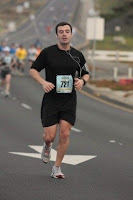
Starting at mile 17, I started to become fatigued but still kept a decent pace of about 7:30 a mile. I was about 10 minutes ahead of my goal for doing a Boston Qualifier. Realizing that I can probably do a sub-3 marathon, I picked up my pace again (even though the fatigue was setting in and my knees and ankles were beginning to ache). I crown my decision to keep faster speed even though my body didn't want to, the dumbest decision of the day. Around mile 21, I developed a twitch in my left hamstring. It became increasingly painful as the miles progressed. This, in addition to achy joints, made me realize that I am in for a very painful 5 miles. However, I was still able to run the following 2 miles, although not very fast. Starting just over mile 23, my hamstring twitch made me stop running. I physically could not!! Every time I tried to take a step with my left leg, my hamstring would contract rapidly, which made me lose my balance. These last 2-3 miles were probably one of the more painful marathon experiences in my life. It took me nearly 40 minutes to cover the last two miles, shattering my goal of qualifying for Boston.
Even though I tried to stay hydrated throughout the race, I realized that the lack of electrolytes may have caused the cramps in my hamstring. Most liquid I drank on course was plain water. However, I think that the biggest mistake I made was going out too fast, too hard. That may have worked as I got a boost of confidence knowing that I am ahead of my goal. However, it was a short-lived hope. As the saying goes, "Slow and Steady wins the Race". I will try this on my next marathon.
Speaking of next marathon, I will be running the Napa Valley Marathon on March 1, 2009. I will take everything I learned from Carlsbad and applying to Napa.
Before I conclude, I would like to thank a few people... My running partner and good friend, Angela Brunson. If it wasn't for her, I would've never done this marathon. Having run 25 marathons and numerous ultramarathons (including the world-famous Badwater), she knows exactly what she's doing, both in terms of training AND injury prevention. In fact, her softball trick is what really helped me to get over my IT Band Syndrome two weeks before the race. In addition to running, she has also inspired me to take up rock climbing, ice skating, adventure racing, and even learning how to ride a motorcycle. So, Thank You Angela.
Next... My Brother, Harout. Harout recently moved in to Los Angeles to live with me. Being fairly inactive and a smoker, as soon as he moved to Los Angeles, he began his path to healthier him. In the first two weeks of being in Los Angeles, Harout has taken up Aikido & Jujitsu, Ice Skating, and he is training for his first ever Marathon with Team in Training. Way to go Bro!!
Last but certainly not least, my girlfriend and my best friend, Cynthia. She has been very supportive of me throughout my weight loss, Ironman training, and overall understanding. If it wasn't for her, I would've never started running, which means I would've never been doing a review of Carlsbad Marathon nor would I have become an Ironman. I am in the best physical shape of my life and I owe majority of my success to Cynthia. Thank you Love!!!
My ultimate goal for doing the Carlsbad marathon was to qualify for the upcoming Boston Marathon. Honestly, I don't really care about actually running Boston, just qualifying for it is succinct for me. The marathon started at 6AM and my hotel was approximately 1 mile from the race start. Purposely, I woke up extra early and decided to jog to the marathon start so that I am warmed up and don't waste any energy in the beginning of the race. I started jogging, only to found out that I was going in the wrong direction. After running for about 10 minutes, I see no cars, no crowds, and no fellow joggers. I became slightly alarmed and decided to walk into a 7-11 to find out where the Westfield Shopping Center was (race start and finish). I was informed that I went completely the wrong direction. If I was slightly nervous then, I became very nervous upon hearing this. With only about 20 minutes to the race start and being about 3 miles away, I literally sprinted those three miles. While I was running at a good pace, I actually felt pretty strong throughout my journey to the start line. I got there a little after 6 and was really glad to hear that the race is being delayed for 15 minutes due to technical difficulties.
I met a few runners, made some friends, and as soon as the clock hit 6:13 AM, the gun went off and the 2009 Carlsbad Marathon had officially begun. The first 6 miles went really well. I was at about 6:30 average pace, with a faster sub-6 on the downhills and slower on the inclines. Feeling great, I decided to step it up a notch. For the next few miles, I was going at about 6:15 pace. At about mile 9, there was a long incline, which lasted for a couple of miles. Wanting to conserve some energy for the flats and the downhills, I decided to tackle this hill quite slowly. Could've gone much faster, but I dropped my pace down to 9-10 minutes per mile for the next 2-3 miles. As soon as the hill was over, I picked up the pace again to average about 7-7:30 pace for the next several miles. The only highlight between mile 10 and 16 is when the half marathon pros zoomed by me at about 4 min/mile pace. It was an incredible thing to watch as the motorcade passed me along with two black runners (possibly from Ethiopia or Kenya).

Starting at mile 17, I started to become fatigued but still kept a decent pace of about 7:30 a mile. I was about 10 minutes ahead of my goal for doing a Boston Qualifier. Realizing that I can probably do a sub-3 marathon, I picked up my pace again (even though the fatigue was setting in and my knees and ankles were beginning to ache). I crown my decision to keep faster speed even though my body didn't want to, the dumbest decision of the day. Around mile 21, I developed a twitch in my left hamstring. It became increasingly painful as the miles progressed. This, in addition to achy joints, made me realize that I am in for a very painful 5 miles. However, I was still able to run the following 2 miles, although not very fast. Starting just over mile 23, my hamstring twitch made me stop running. I physically could not!! Every time I tried to take a step with my left leg, my hamstring would contract rapidly, which made me lose my balance. These last 2-3 miles were probably one of the more painful marathon experiences in my life. It took me nearly 40 minutes to cover the last two miles, shattering my goal of qualifying for Boston.
Even though I tried to stay hydrated throughout the race, I realized that the lack of electrolytes may have caused the cramps in my hamstring. Most liquid I drank on course was plain water. However, I think that the biggest mistake I made was going out too fast, too hard. That may have worked as I got a boost of confidence knowing that I am ahead of my goal. However, it was a short-lived hope. As the saying goes, "Slow and Steady wins the Race". I will try this on my next marathon.
Speaking of next marathon, I will be running the Napa Valley Marathon on March 1, 2009. I will take everything I learned from Carlsbad and applying to Napa.
Before I conclude, I would like to thank a few people... My running partner and good friend, Angela Brunson. If it wasn't for her, I would've never done this marathon. Having run 25 marathons and numerous ultramarathons (including the world-famous Badwater), she knows exactly what she's doing, both in terms of training AND injury prevention. In fact, her softball trick is what really helped me to get over my IT Band Syndrome two weeks before the race. In addition to running, she has also inspired me to take up rock climbing, ice skating, adventure racing, and even learning how to ride a motorcycle. So, Thank You Angela.
Next... My Brother, Harout. Harout recently moved in to Los Angeles to live with me. Being fairly inactive and a smoker, as soon as he moved to Los Angeles, he began his path to healthier him. In the first two weeks of being in Los Angeles, Harout has taken up Aikido & Jujitsu, Ice Skating, and he is training for his first ever Marathon with Team in Training. Way to go Bro!!
Last but certainly not least, my girlfriend and my best friend, Cynthia. She has been very supportive of me throughout my weight loss, Ironman training, and overall understanding. If it wasn't for her, I would've never started running, which means I would've never been doing a review of Carlsbad Marathon nor would I have become an Ironman. I am in the best physical shape of my life and I owe majority of my success to Cynthia. Thank you Love!!!
Wednesday, January 28, 2009
Favorite Fat Loss Exercises
As promised, here are my three favorite exercises for fat loss.
Before going into too much detail, from my previous post, it should be obvious that in order to lose body fat, one must create a calorie deficit. So, instead of listing the best exercises for fat loss, I will list exercises, which burn the most amount of calories.
1. Running

If done correctly running is by far the best exercise to burn the maximum amount of calories in the shortest amount of time. In addition, it's inexpensive and requires no additional equipment other than a good pair of running shoes and some basic attire. The hype about running being dangerous is just pure nonsense. However, this only applies if running is done correctly. Wearing improper/worn-out running shoes, form imperfections, doing more than your body can handle, and other issues will most likely lead to injury. So, take some time, learn the basics of running, and you're off.
Why is running so efficient for burning calories? One of the biggest reason is that while one burns lots of calories during the activity, running also makes people burn calories after. It is a high-impact activity and there is definitely tissue damage taking place (nothing to be too concerned about, if done properly). Therefore, right after running, the body uses much energy to repair all those tissues and prep you for running session #2. Also, running not only involves the legs, but also the upper body. This results in more blood circulation, which results in a faster heart rate. This also plays an incremental role in increased calorie expenditure.
2. Cycling/Spinning

Contrary to running cycling is a very low-impact activity. An ordinary person may not be able to run for 90 minutes nonstop, but they may very well be able to cycle for 90 minutes. More minutes translate to more calories. While easy pace cycling on a flat road doesn't burn as much calories as running, it oftentimes can be a more enjoyable form of exercise. Ideally, the heart rate stays slightly lower while cycling simply because the upper body doesn't do much. Friends may decide to have a 3-hour leisurely ride on a Saturday afternoon or just head to the store located about 20 miles away to buy some basic groceries. Point being, cycling doesn't have to be considered an exercise, rather a hobby, which burns calories on the side.
Spinning, typically done in increments of 45-60 minutes, burns much more calories than leisurely cycling. The fact that most spin classes integrate intervals, simulate climbing, and also recovery translates to increased calorie expenditures. Hill climbing on a bicycle is also a great way of burning increased amount of calories. However, hill climbing (depending on the grade) is much more strenuous and may not be suitable for those who are just beginning. On contrary, most spin classes allow you to go at your own pace, set your own intensity and resistance, therefore, the experience is customized to your liking.
3. Weight Training

I do realize that "weight training" is quite vague, but point being, it is, or at least should be an important part of any one's fat loss plan. Weight training in itself doesn't burn a lot of calories, at least not when compared to running and cycling. However, weight training is essential for increased metabolism. Muscle is a metabolic tissue (as opposed to fat). The more muscle one has, the more calories they burn at rest. If doing cardio is the primary source of calorie expenditure, then muscle is bound to be lost triggering a decrease in metabolism. Weight training helps preserve those muscles and thus keep the metabolism at a constant level.
So, how many calories???
These numbers are based on one of my clients' fitness GPS (with HR monitor) readouts. I'll call him Mark, even though that's not his real name. Here are Mark's statistics:
Height: 5'7"
Weight: 186
Before going into too much detail, from my previous post, it should be obvious that in order to lose body fat, one must create a calorie deficit. So, instead of listing the best exercises for fat loss, I will list exercises, which burn the most amount of calories.
1. Running
If done correctly running is by far the best exercise to burn the maximum amount of calories in the shortest amount of time. In addition, it's inexpensive and requires no additional equipment other than a good pair of running shoes and some basic attire. The hype about running being dangerous is just pure nonsense. However, this only applies if running is done correctly. Wearing improper/worn-out running shoes, form imperfections, doing more than your body can handle, and other issues will most likely lead to injury. So, take some time, learn the basics of running, and you're off.
Why is running so efficient for burning calories? One of the biggest reason is that while one burns lots of calories during the activity, running also makes people burn calories after. It is a high-impact activity and there is definitely tissue damage taking place (nothing to be too concerned about, if done properly). Therefore, right after running, the body uses much energy to repair all those tissues and prep you for running session #2. Also, running not only involves the legs, but also the upper body. This results in more blood circulation, which results in a faster heart rate. This also plays an incremental role in increased calorie expenditure.
2. Cycling/Spinning
Contrary to running cycling is a very low-impact activity. An ordinary person may not be able to run for 90 minutes nonstop, but they may very well be able to cycle for 90 minutes. More minutes translate to more calories. While easy pace cycling on a flat road doesn't burn as much calories as running, it oftentimes can be a more enjoyable form of exercise. Ideally, the heart rate stays slightly lower while cycling simply because the upper body doesn't do much. Friends may decide to have a 3-hour leisurely ride on a Saturday afternoon or just head to the store located about 20 miles away to buy some basic groceries. Point being, cycling doesn't have to be considered an exercise, rather a hobby, which burns calories on the side.
Spinning, typically done in increments of 45-60 minutes, burns much more calories than leisurely cycling. The fact that most spin classes integrate intervals, simulate climbing, and also recovery translates to increased calorie expenditures. Hill climbing on a bicycle is also a great way of burning increased amount of calories. However, hill climbing (depending on the grade) is much more strenuous and may not be suitable for those who are just beginning. On contrary, most spin classes allow you to go at your own pace, set your own intensity and resistance, therefore, the experience is customized to your liking.
3. Weight Training
I do realize that "weight training" is quite vague, but point being, it is, or at least should be an important part of any one's fat loss plan. Weight training in itself doesn't burn a lot of calories, at least not when compared to running and cycling. However, weight training is essential for increased metabolism. Muscle is a metabolic tissue (as opposed to fat). The more muscle one has, the more calories they burn at rest. If doing cardio is the primary source of calorie expenditure, then muscle is bound to be lost triggering a decrease in metabolism. Weight training helps preserve those muscles and thus keep the metabolism at a constant level.
So, how many calories???
These numbers are based on one of my clients' fitness GPS (with HR monitor) readouts. I'll call him Mark, even though that's not his real name. Here are Mark's statistics:
Height: 5'7"
Weight: 186
- One hour of easy running (heart rate between 135-145) yields approximately 720 calories.
- One hour of medium intensity running (heart rate between 145-155) yields approximately 890 calories.
- 30 minutes of high intensity running yields about 550 calories
- One hour of easy cycling = 520 calories
- One hour of medium intensity cycling = 750 calories
- 30 minutes of climbing (6% grade) = 500 calories
- One hour spin class = 920 calories
- One hour full body weight training = 300 calories (approx)
Wednesday, January 14, 2009
The Best Tasting Cheeseburger EVER
I don't typically blog about my day-to-day activities simply because it's not interesting. I mean, wake up early, run, bike, go to work, swim, and run some more. Who wants to hear about that right? Well, I am making an exception this time and would like to comment about the best tasting cheeseburger I have ever had. Beast your eyes on this:
 Yup, that's right. It's Jack-in-the-Box' Ultimate Cheeseburger. Now, before I go on, let me make it clear that I don't work for Jack nor am I being paid to advertise their crappy food. Did I just say crappy? What I really meant was "the most delicious cheeseburger on the planet".
Okay Arkady, get to the damn point!!!!
Here it is....
Last night, after my regular swim session, I became alarmingly hungry. For those who do not swim competitively, swimming is by far the worse exercise you can do for fat loss. Why? Michael Phelps has rock hard abs, so it has obviously worked for him right? Well, Michael swims on average 6-8 hours a day and he also eats more food in a day that most people do in a month. But for regular folks, swimming tends to increase the appetite astronomically. Some studies suggest that an average swimmer consumes nearly three times as many calories after the swim than the calories burned while swimming. Now, there is more to life than burning calories. The undeniable fact that swimming is probably the best exercise you can do to benefit your heart and lungs really outweighs the calorie factor. If you really want to increase your endurance, VO2 Max, both aerobic and anaerobic thresholds, then start swimming. It is also by far the safest activity (providing you know how to swim) in a sense that it creates the least impact (again, providing you don't bump your head on the wall). So, while swimming may not be the most efficient activity to create a calorie deficit, it is by far the most beneficial in terms of health and overall fitness. HINT: To avoid overeating after the swim, try consuming carbohydrate-rich calories about 30 minutes prior to getting in the water. Potatoes would be a good example, and so would sugary cereal (no milk). They key here is to consume about 200 calories beforehand and as soon as the swim is over, consume another 100-200 calories of the same food but with some protein to aid muscle recovery. Do this and you can freely use swimming as part of your fat loss plan AND get all the aerobic and anaerobic benefits. Have your cake and eat it too!!! Don't forget to hydrate constantly, even while in the pool.
Now, I may have just deviated on a tangent. I was speaking about the best cheeseburger ever before I started ranting about the benefits and drawbacks of swimming. So, here I go...
After my Tuesday swim session, my hypothalamus informed my frontal cortex of the hunger issue. So, instead of waiting to go home, I just pulled into the nearest fast food joint in the area, which happened to be Jack-in-the-Box and proudly order 1 Ultimate Cheeseburger. The cheeseburger itself wasn't made any different. It had the same bun, 2 day old lettuce, aged tomatoes, and 2 well-cooked pieces of beef patties, which seemed like it was frozen for about 2 years before they decided to thaw and serve. However, this paired with my increase appetite and craving for food, it was, INDEED, the best tasting cheeseburger I have ever had.
Stay tuned next week for my top-three favorite exercises for fat loss and why.
 Yup, that's right. It's Jack-in-the-Box' Ultimate Cheeseburger. Now, before I go on, let me make it clear that I don't work for Jack nor am I being paid to advertise their crappy food. Did I just say crappy? What I really meant was "the most delicious cheeseburger on the planet".
Okay Arkady, get to the damn point!!!!
Here it is....
Last night, after my regular swim session, I became alarmingly hungry. For those who do not swim competitively, swimming is by far the worse exercise you can do for fat loss. Why? Michael Phelps has rock hard abs, so it has obviously worked for him right? Well, Michael swims on average 6-8 hours a day and he also eats more food in a day that most people do in a month. But for regular folks, swimming tends to increase the appetite astronomically. Some studies suggest that an average swimmer consumes nearly three times as many calories after the swim than the calories burned while swimming. Now, there is more to life than burning calories. The undeniable fact that swimming is probably the best exercise you can do to benefit your heart and lungs really outweighs the calorie factor. If you really want to increase your endurance, VO2 Max, both aerobic and anaerobic thresholds, then start swimming. It is also by far the safest activity (providing you know how to swim) in a sense that it creates the least impact (again, providing you don't bump your head on the wall). So, while swimming may not be the most efficient activity to create a calorie deficit, it is by far the most beneficial in terms of health and overall fitness. HINT: To avoid overeating after the swim, try consuming carbohydrate-rich calories about 30 minutes prior to getting in the water. Potatoes would be a good example, and so would sugary cereal (no milk). They key here is to consume about 200 calories beforehand and as soon as the swim is over, consume another 100-200 calories of the same food but with some protein to aid muscle recovery. Do this and you can freely use swimming as part of your fat loss plan AND get all the aerobic and anaerobic benefits. Have your cake and eat it too!!! Don't forget to hydrate constantly, even while in the pool.
Now, I may have just deviated on a tangent. I was speaking about the best cheeseburger ever before I started ranting about the benefits and drawbacks of swimming. So, here I go...
After my Tuesday swim session, my hypothalamus informed my frontal cortex of the hunger issue. So, instead of waiting to go home, I just pulled into the nearest fast food joint in the area, which happened to be Jack-in-the-Box and proudly order 1 Ultimate Cheeseburger. The cheeseburger itself wasn't made any different. It had the same bun, 2 day old lettuce, aged tomatoes, and 2 well-cooked pieces of beef patties, which seemed like it was frozen for about 2 years before they decided to thaw and serve. However, this paired with my increase appetite and craving for food, it was, INDEED, the best tasting cheeseburger I have ever had.
Stay tuned next week for my top-three favorite exercises for fat loss and why.
Tuesday, January 13, 2009
Abandoning my New Mission
Dear Friends,
I have decided to abandon my mission of having a clearly defined six-pack by March 1, 2009. While this action on my part may indicate failure, and if you'd to think of it as such, that's fine. However, I would like to clarify a few miss-conceptions and hope that you, my dear reader may place this in a separate context. First of all, my decision to abandon the mission isn't based on the difficulty and the commitment required to accomplish my goal. Ask any fitness professional who know what they're talking about and they will tell you that in order to have a clearly defined abdominal muscles one needs to lose body fat. In order to lose body fat, that someone must create a calorie deficit. Now, what is a calorie deficit? Simply put, it is the act of consuming less calories than your body burns. As some of you know, I have dubbed myself to be an endurance athlete and my race calendar for 2009 is quite full of races and events. Starting with Carlsbad Marathon on January 25, 2009 and finishing with an Ultramarathon in December of 2009. Throw in a couple of Ironmans, and a half Ironmen between, and you literally have a full time job called "training". Add to this, my other full time job which actually brings in money to pay for the expenses caused by the "other" job. The nutritional requirements for someone on a fat loss plan doesn't necessarily coincide with someone training for a marathon or an Ironman. For example, many fat loss experts advocate whole grain and whole wheat as preferable carbohydrate sources and discourage of simple carbohydrates while on a fat loss plan. However, while the aforementioned sources are an important part of anyone's diet, starchy foods such as white bread and potatoes are also preferred carb sources for endurance athletes.
In the past few weeks, I have found myself transitioning back to fat loss nutrition and quite honestly, my endurance performance has suffered because of it. I have increasingly found myself with less energy throughout the day and I dehydrate faster during my training. Therefore, I feel like I would be doing a disfavor to my athletic endeavors and ultimately my body by continuing to be on a strict fat loss plan.
I will continue updating my blog and will make extra time to increase the frequency. In the meantime, if you reside in Southern California, please visit and sign up for my running group:
http://www.meetup.com/The-Santa-Monica-Running-Group/
You can also be my facebook friend
In an unrelated note, Tom Venuto, my all time fitness and fat loss mentor has just published a new book titled "The Body Fat Solution". It is NOT your ordinary diet book... Get more information by visiting:
http://www.thebodyfatsolution.com/
It is also available in audio version from http://audible.com
I have decided to abandon my mission of having a clearly defined six-pack by March 1, 2009. While this action on my part may indicate failure, and if you'd to think of it as such, that's fine. However, I would like to clarify a few miss-conceptions and hope that you, my dear reader may place this in a separate context. First of all, my decision to abandon the mission isn't based on the difficulty and the commitment required to accomplish my goal. Ask any fitness professional who know what they're talking about and they will tell you that in order to have a clearly defined abdominal muscles one needs to lose body fat. In order to lose body fat, that someone must create a calorie deficit. Now, what is a calorie deficit? Simply put, it is the act of consuming less calories than your body burns. As some of you know, I have dubbed myself to be an endurance athlete and my race calendar for 2009 is quite full of races and events. Starting with Carlsbad Marathon on January 25, 2009 and finishing with an Ultramarathon in December of 2009. Throw in a couple of Ironmans, and a half Ironmen between, and you literally have a full time job called "training". Add to this, my other full time job which actually brings in money to pay for the expenses caused by the "other" job. The nutritional requirements for someone on a fat loss plan doesn't necessarily coincide with someone training for a marathon or an Ironman. For example, many fat loss experts advocate whole grain and whole wheat as preferable carbohydrate sources and discourage of simple carbohydrates while on a fat loss plan. However, while the aforementioned sources are an important part of anyone's diet, starchy foods such as white bread and potatoes are also preferred carb sources for endurance athletes.
In the past few weeks, I have found myself transitioning back to fat loss nutrition and quite honestly, my endurance performance has suffered because of it. I have increasingly found myself with less energy throughout the day and I dehydrate faster during my training. Therefore, I feel like I would be doing a disfavor to my athletic endeavors and ultimately my body by continuing to be on a strict fat loss plan.
http://www.meetup.com/The-Santa-Monica-Running-Group/
You can also be my facebook friend
In an unrelated note, Tom Venuto, my all time fitness and fat loss mentor has just published a new book titled "The Body Fat Solution". It is NOT your ordinary diet book... Get more information by visiting:
http://www.thebodyfatsolution.com/
It is also available in audio version from http://audible.com
Subscribe to:
Posts (Atom)